

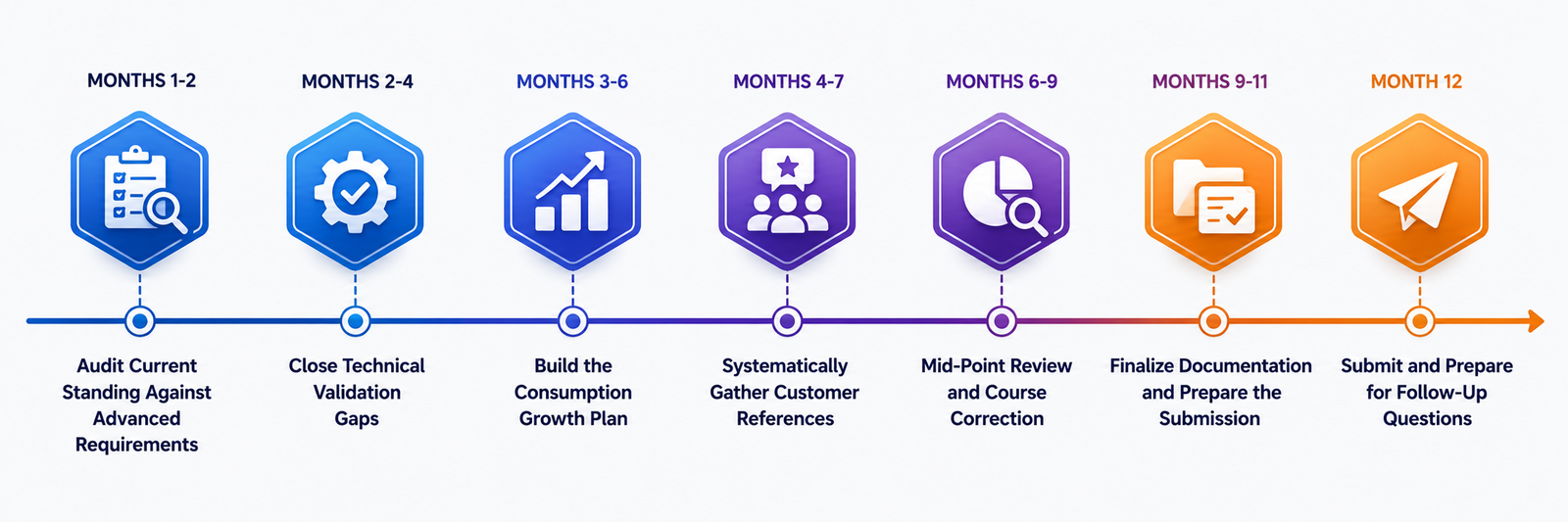
Partners who successfully move from Select to Advanced tier rarely do it by accident. They treat the move as a project with a timeline, not a hoped-for outcome of general business growth. This roadmap breaks the work into a 12-month sequence, front-loading the requirements that take longest to satisfy and building toward the review itself.
Months 1-2: Audit Current Standing Against Advanced Requirements
The first step is a clear-eyed audit of where the partner currently stands against every documented Advanced tier requirement: consumption revenue thresholds, number and quality of customer references, technical validation status, and program participation history. Most partners skip this step and instead work off an assumption of what is missing, which often turns out to be incomplete or outdated. A proper audit surfaces the real gaps, not the perceived ones, and those are frequently different.
Months 2-4: Close Technical Validation Gaps
Technical validations, where required, tend to take the longest to complete because they often involve documentation, architecture review, and sometimes remediation work. Starting this early is critical because technical validation timelines are the least compressible part of the process. Partners who leave this until month nine or ten of a twelve-month plan frequently find there is not enough runway left to complete it properly.
Months 3-6: Build the Consumption Growth Plan
Using the deal structure principles covered earlier in this series, this phase focuses on making sure new and existing deals are structured to count cleanly toward consumption revenue: prioritizing Private Offers and CPPO where applicable, closing tracking gaps identified in the audit phase, and setting explicit internal consumption targets tied to the Advanced tier threshold. This phase runs in parallel with technical validation work rather than sequentially after it, since consumption growth needs the longest runway of any requirement to show a meaningful trend.
Months 4-7: Systematically Gather Customer References
Customer references need to be gathered deliberately, not assembled last-minute from whichever customers happen to respond quickly. This phase involves identifying the strongest candidate customers, formally requesting references through whatever process AWS requires, and following up methodically, since reference collection often stalls due to slow customer response times rather than customer reluctance. Starting this in month four gives enough buffer for the inevitable delays.
Months 6-9: Mid-Point Review and Course Correction
At the halfway point, the partner should reassess progress against every requirement identified in the initial audit. This is the point to identify which requirements are tracking on schedule and which are falling behind, and to reallocate effort accordingly. A mid-point review catches problems with enough runway left to actually fix them, rather than discovering a shortfall in month eleven with no time to respond.
Months 9-11: Finalize Documentation and Prepare the Submission
With technical validation, consumption growth, and references largely in place, this phase focuses on assembling everything into the format AWS requires for tier review: documentation of technical validation, consumption reporting, formal customer references, and any additional program requirements specific to the partner’s category. This is also the point to do an internal dry-run review, checking the submission as if evaluating it from AWS’s perspective, to catch gaps before the actual review does.
Month 12: Submit and Prepare for Follow-Up Questions
The final month is for submission and for staying responsive to any follow-up questions or requests for additional documentation from AWS. Partners who have done the preceding eleven months of work properly rarely face major surprises at this stage, but staying available and responsive during the review window still matters, since delays in responding to AWS follow-ups can push a review into a subsequent cycle unnecessarily.
Strategic Takeaway
Advanced tier is reachable on a predictable timeline when the requirements are audited early and sequenced deliberately, with the longest-lead items, technical validation and consumption growth, started first. Partners who wait until close to a review to start this work are working against timelines that cannot realistically be compressed, which is the single biggest reason tier progression stalls.
Ready to build a real roadmap toward Advanced tier instead of hoping it happens eventually? Marketeering helps AWS partners audit their current standing and build a sequenced plan to close every gap.
